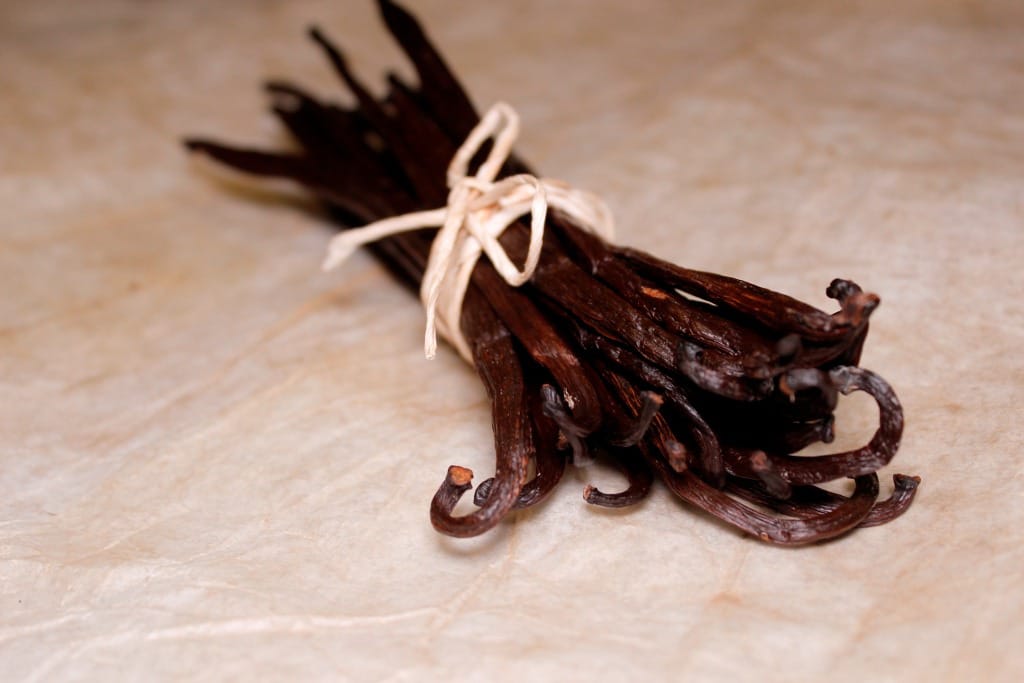
Vanilla is a spice derived from orchids of the genus Vanilla, primarily obtained from pods of the Mexican species, flat-leaved vanilla (V. planifolia).
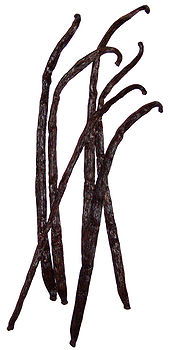
Pollination is required to make the plants produce the fruit from which the vanilla spice is obtained. In 1837, Belgian botanist Charles François Antoine Morren discovered this fact and pioneered a method of artificially pollinating the plant. The method proved financially unworkable and was not deployed commercially. In 1841, Edmond Albius, a 12-year-old slave child who lived on the French island of Réunion in the Indian Ocean, discovered that the plant could be hand-pollinated. Hand-pollination allowed global cultivation of the plant. Noted French botanist and plant collector Jean Michel Claude Richard falsely claimed to have discovered the technique three or four years earlier. By the end of the 20th century, Albius was considered the true discoverer.
Three major species of vanilla currently are grown globally, all of which derive from a species originally found in Mesoamerica, including parts of modern-day Mexico. They are V. planifolia (syn. V. fragrans), grown on Madagascar, Réunion, and other tropical areas along the Indian Ocean; V. tahitensis, grown in the South Pacific; and V. pompona, found in the West Indies, Central America, and South America. The majority of the world's vanilla is the V. planifolia species, more commonly known as Bourbon vanilla (after the former name of Réunion, Île Bourbon) or Madagascar vanilla, which is produced in Madagascar and neighboring islands in the southwestern Indian Ocean, and in Indonesia. Madagascar's and Indonesia's cultivations produce two-thirds of the world's supply of vanilla.
Vanilla is the second-most expensive spice after saffron because growing the vanilla seed pods is labor-intensive. Nevertheless, vanilla is widely used in both commercial and domestic baking, perfume production, and aromatherapy.
Vanilla planifolia traditionally grew wild around the Gulf of Mexico from Tampico around to the northeast tip of South America, and from Colima to Ecuador on the Pacific side, as well as throughout the Caribbean. The Totonac people, who live along the eastern coast of Mexico in the present-day state of Veracruz, were among the first people to domesticate vanilla, cultivated on farms since at least 1185. The Totonac used vanilla as a fragrance in temples and as a good-luck charm in amulets, as well as flavoring for food and beverages. The cultivation of vanilla was a low-profile affair, as few people from outside these regions knew of it.
Although the Totonacs are the most famously associated with human use of vanilla, it is speculated that the Olmecs, who also lived in the regions of wild vanilla growth thousands of years earlier, were one of the first people to use wild vanilla in cuisine.
Aztecs from the central highlands of Mexico invaded the Totonacs in 1427, developed a taste for the vanilla pods, and began using vanilla to flavor their foods and drinks, often mixing it with cocoa in a drink called "xocolatl" that later inspired modern hot chocolate. The fruit was named tlilxochitl, or "black flower", because the matured fruit shrivels and turns a dark color shortly after being picked. For the Aztecs, much like earlier Mesoamerican peoples before them, it is probable that vanilla was used to tame the otherwise bitter taste of cacao, as sugarcane was not harvested in these regions at the time and there were no other sweeteners available.
Hernán Cortés is credited with introducing both vanilla and chocolate to Europe in the 1520s. In Europe, vanilla was seen mostly as an additive to chocolate until the early 17th century when Hugh Morgan, a creative apothecary in the employ of Queen Elizabeth I, created chocolate-free, vanilla-flavored "sweetmeats". By the 18th century, the French were using vanilla to flavor ice cream.
Until the mid-19th century, Mexico was the chief producer of vanilla. In 1819, French entrepreneurs shipped vanilla fruits to the islands of Réunion and Mauritius in hopes of producing vanilla there. After 1841, when Edmond Albius discovered how to pollinate the flowers quickly by hand, the pods began to thrive. Soon, the tropical orchids were sent from Réunion to the Comoros Islands, Seychelles, and Madagascar, along with instructions for pollinating them.
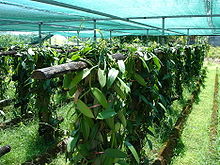
The main species harvested for vanilla is V. planifolia. Although it is native to Mexico, it is now widely grown throughout the tropics. Indonesia and Madagascar are the world's largest producers. Additional sources include V. pompona and V. tahitiensis (grown in Niue and Tahiti), although the vanillin content of these species is much less than V. Planifolia.
Vanilla grows as a vine, climbing up an existing tree (also called a tutor), pole, or other support. It can be grown in a wood (on trees), in a plantation (on trees or poles), or in a "shader", in increasing orders of productivity. Its growth environment is referred to as its terroir, and includes not only the adjacent plants, but also the climate, geography, and local geology. Left alone, it will grow as high as possible on the support, with few flowers. Every year, growers fold the higher parts of the plant downward so the plant stays at heights accessible by a standing human. This also greatly stimulates flowering.
The distinctively flavored compounds are found in the fruit, which results from the pollination of the flower. These seed pods are roughly a third of an inch (8 mm) by six inches (15 cm), and brownish red to black when ripe. Inside of these pods is an oily liquid full of tiny seeds. One flower produces one fruit. V. planifolia flowers are hermaphroditic: they carry both male (anther) and female (stigma) organs. However, self-pollination is blocked by a membrane which separates those organs. Despite various claims otherwise, the only pollinators definitively documented to date are orchid bees in the genus Eulaema, and all commercial vanilla production takes place via hand pollination by humans. The first vanilla orchid to flower in Europe was in the London collection of the Honourable Charles Greville in 1806. Cuttings from that plant went to Netherlands and Paris, from which the French first transplanted the vines to their overseas colonies. The vines grew, but would not fruit outside Mexico. Growers tried to bring this bee into other growing locales, to no avail. The only way to produce fruits without the bees is artificial pollination. Today, even in Mexico, hand pollination is used extensively.
In 2020, world production of vanilla was 7,614 tonnes, led by Madagascar with 39.1% of the total, and Indonesia with 30.3% (table). Due to drought, cyclones, and poor farming practices in Madagascar, there are concerns about the global supply and costs of vanilla in 2017 and 2018. The intensity of criminal enterprises against Madagascar farmers is high, elevating the worldwide cost of using Madagascar vanilla in consumer products.